
There is the Switzerland of the bucket list: the Matterhorn, Alpine cowbells and the unmistakable red carriages of the Glacier Express. And then there is the Switzerland you discover when someone who really knows the country tells you where they would go themselves.
For the latest edition of Swiss Bliss, their strategic marketing partnership campaign, Rail Europe and Swiss Travel System asked four people with close connections to Switzerland to share the journey they would genuinely recommend to a friend: Rail Europe CEO and Bern local Björn Bender; Swiss Travel System expert Thomas Hoffmann; Rail Europe CTO Ilgün Ilgün; and Europe by Railauthors Nicky Gardner and Susanne Kries.
Not necessarily the most famous route, but one they know, value and happily return to. Designed for autumn and winter too, the four journeys are less about ticking off sights than knowing where to stop, get off the train or take a detour.
Put phone on Do Not Disturb: Bern, Lake Geneva and the Lötschental
Bern → Montreux → Lausanne → Bern / Bern → Goppenstein → Wiler → Lauchernalp → Bern
Day one heads towards Lake Geneva: walk from Montreux towards Clarens or Château de Chillon, then continue to Lausanne for steep streets, neighbourhood cafés and views towards France. Café de Grancy is a good local stop, while the Lavaux vineyards are another reason not to rush back.
The next morning goes towards the mountains. From Goppenstein, a PostBus continues through the Lötschental to Wiler, followed by a cable car to Lauchernalp, at almost 2,000 metres. Walk, have lunch on a terrace and try a glass of Valais wine before heading down.
In autumn, the vineyards turn colour as the high valleys quieten. In winter, the contrast is sharper: lakeside cities one day, snow and mountain villages the next.
Switzerland, speaking Italian: Locarno, Ascona and the valleys of Ticino
Zurich → Locarno → Ascona → Maggia Valley → Ponte Brolla / Centovalli → Intragna → Bellinzona → Zurich
Travelling south from Zurich on the Gotthard route, the landscape gradually shifts to stone houses, piazzas, palm trees and Italian voices.
Locarno is a good base for an afternoon in lakeside Ascona or exploring the Maggia Valley on foot or by bike, starting around Ponte Brolla. The Centovalli railway towards Intragna runs through ravines, chestnut forests and stone bridges, while Bellinzona brings three medieval castles into the journey.
Autumn brings mild temperatures and changing chestnut forests; in winter, palm trees against snow-covered mountains create one of Switzerland’s more unexpected scenes.
Switzerland is better understood through food: Vevey, Montreux, Gruyères and Broc
Basel → Vevey → Montreux → Gruyères → Broc → Basel
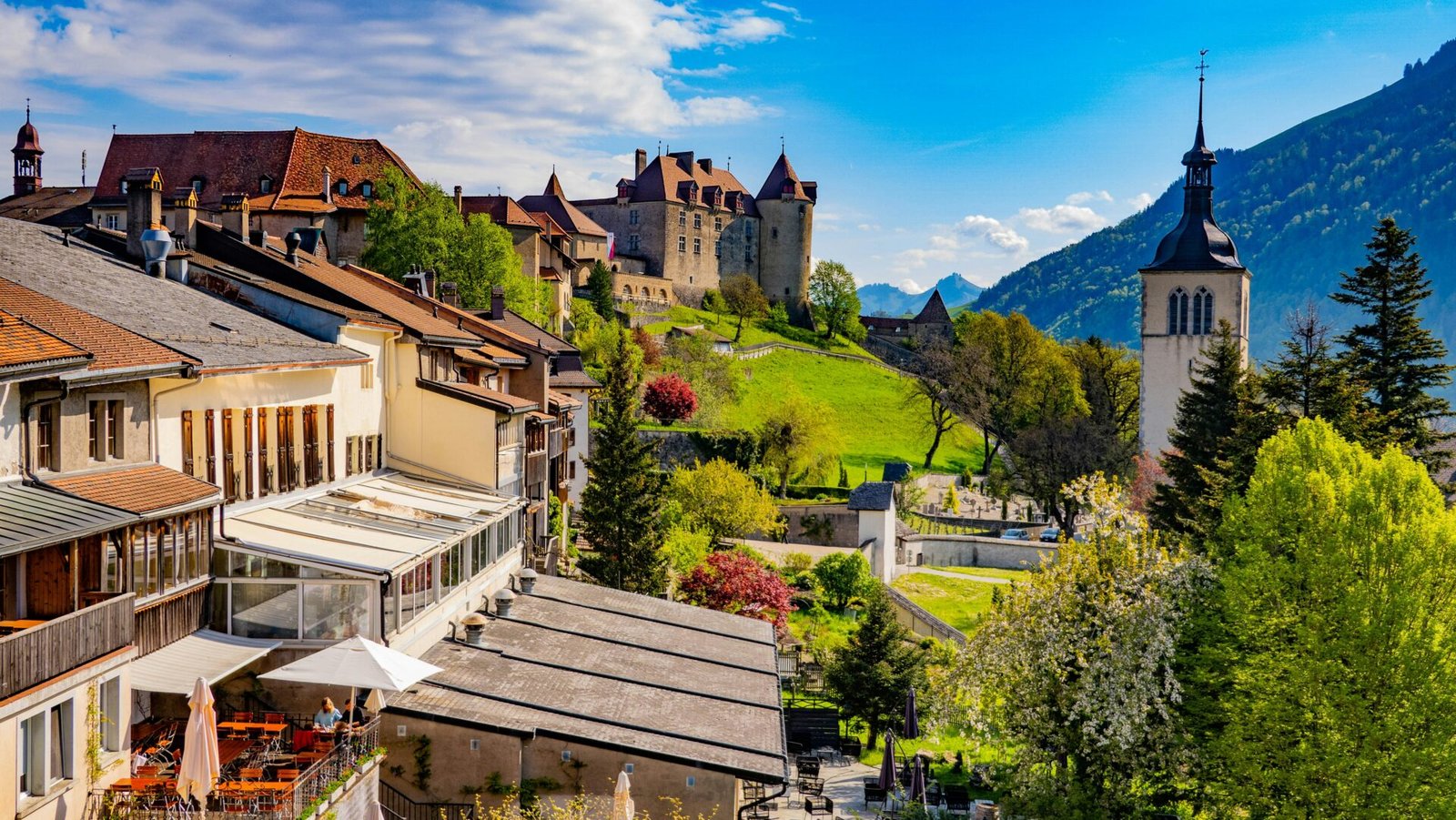
Basel, the route heads to Vevey and the wine country around Lake Geneva before following the lake towards Montreux. Inland, Gruyères connects its famous cheese with the dairy farms and traditions of the surrounding landscape.
Broc adds chocolate, while small bakeries and independent producers offer less expected discoveries, including award-winning panettone made far from where most travellers would associate it.
It is a journey from vineyard to glass, pasture to cheese and cocoa to chocolate. Autumn brings harvest season and longer meals; in winter, food becomes an even better reason to get off the train.
Watching Switzerland change language from the train window
St Gallen → Landquart → Zernez → Val Müstair → Pontresina → Alp Grüm → Tirano
It begins in St Gallen, where the UNESCO-listed abbey district sits beside an old town with 111 decorated bay windows. The railway follows the Rhine Valley towards Landquart before turning into the Alps. By Zernez, gateway to the Swiss National Park, Romansh appears alongside German and the Engadin landscape takes over.
A PostBus continues into Val Müstair, home to the eighth-century, UNESCO-listed Convent of St John and its early medieval frescoes. The railway then leads through Pontresina and on to Alp Grüm, at 2,091 metres, directly facing the Palü Glacier. There is no road to the station: the only way in or out is by train or on foot.
From there, the Bernina line descends into Italy, as high Alpine terrain gives way to forests and villages before reaching Tirano and its Basilica of Madonna di Tirano.
In autumn, the Engadin larches turn gold. In winter, the landscape becomes almost monochrome at altitude before changing completely on the descent towards Italy.
Each recommendation was turned into a hand-illustrated postcard and sent to a travel creator, who followed and shared the journey. Travellers can recreate the routes using the Swiss Travel Pass, point-to-point tickets, regional passes or mountain excursions.