

The first rays found us through the gate, driving north. Things were rather quiet this morning. Our dusty car with a cracked windscreen, gliding along the non-metal road, hadn’t disturbed the equilibrium of the jungle. (Not yet, anyway)
By Inder Raj Ahluwalia
5 a.m. isn’t quite the time to notice any finer details, so we didn’t bother. The sun was still only hinting at its presence on the eastern horizon as we left the cosy confines of Makuti Lodge.
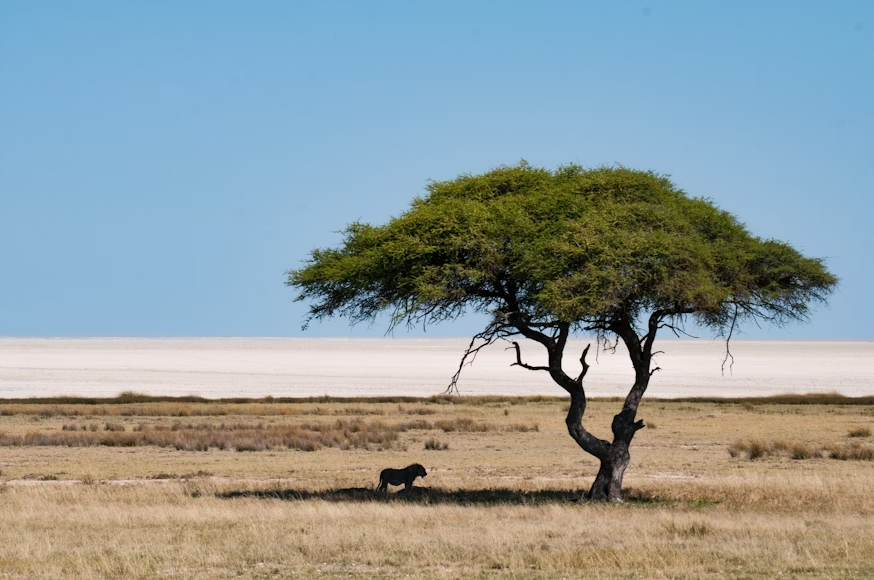
We were in the famed Etosha Park in northern Namibia, an outstanding wilderness area and conservation case-study, and the natural habitat of hundreds of animal and bird species including the famous ‘Big Five’. Etosha literally means ‘the great white place of dry water’, an apt description considering its barrenness! Most game parks don’t have the space, but here we had been driving for two hours and were still far from its centre, one reason being that there is no centre or core area. The entire park is core area and home to game, encircled by electrified wire to fence in the animals. (And keep out the humans…!)
Spanning some 22,700 sq km, Etosha is almost a country by itself in terms of vastness and physical diversity. If comparisons interest you, it is ten times the size of Luxembourg.
Ignoring the park’s official speed limit, of 60 kmph, we were dpoing a steady 80, our over-speeding justified by the straightness of the roads, the complete lack of traffic, and a late breakfast and start. The landscape changed literally by the minute, wooded areas giving way to vast flatlands, open meadows, bush-land, and forests. The only break in the basic dryness came by way of the acacia, among the world’s hardiest and most durable trees and the mainstay of the African bush.
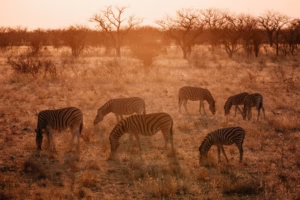
In keeping with the trend in Southern Africa, in Etosha the light falls on shrubs and mopane grass, making animals visible even from a distance. The density and rich diversity of game thriving in a near-desert environment makes Etosha rank amongst the highest- rated parks in game-rich Southern Africa. Elephant, leopard, lion, black rhino, white rhino, and cheetah, roam through the acacia groves and savanna. Antelope are present in thousands, and include zebra, kudu, impala, and wildebeest, grazing on vegetation where they can find it. Scavengers like spotted hyenas and jackals follow predators ’hunting tracks, crying late into the night. Perhaps, watching all this from a safe haven is Africa’s smallest antelope, the Damara Dik Dik.
The day had gone by in a flash. The park authorities like to see all visitors safely out of the gates by dusk, so nightfall found us back at the Makuti Lodge, located just outside one of the park’s gates, featuring wide-open spaces, sprawling low structures, a boma-style dining area, and the proverbial swimming pool. This was customary barbecue time. And tomorrow was another day.
We woke to the smell of freshly brewed coffee, excited at the day that lay ahead. A half hour with a huge breakfast crammed in, found us back in the park, on another dusty road. Sunrise in Etosha is an experience to be long cherished. The sky was ablaze with birds. There were crimson-breasted shrike that perch on several types of trees, and thread the park with song. There were weaver birds that build communal nests that make even big branches sag, and there were the great raptors that drop out of the blue like arrows. High up in the skies, making concentric circles, was a Tawny Eagle watching over proceedings.
You might say there are two Etoshas. The dry winter sees game converging around natural springs and on the wide Andoni Plains. There are as many water holes here as there are patches on a giraffe’s neck, but for the best game-viewing, head for select ones like Gaus, Arroe, and Klein Namatoni. The concentration of game around water holes is one of Etosha’s main assets. The wet summer shows the park’s other face, with game migrating westwards as newborn animals celebrate the cycle of creation.
Covering about a fifth of the total area is the Etosha Pan-the heart of the park-a unique and beautiful eco-system and a famous landmark in its own right. Miles and miles of completely flat salt plain form a unique geographical phenomena. Comprised of huge stretches of savanna, with flat lands of limestone and endlessly stretching golden grass, the Pan is a unique stretch of wilderness. Once there was a lake here, one of the world’s largest. Then, eons ago the earth shifted and the lake drifted into the ocean, and the sun shrank the pan, leaving behind deposits of mineral salt. The result is beauty personified, as we saw to our immense satisfaction.
When nature is kind, rain evokes the ancient lake and surrounds it with green. But this is rare, and mostly the Pan remains true to its name. A bone-dry water place, caked, parched, barren, and haunting beautiful as animal tracks criss-cross its length and breadth before fading into the distance and merging with the horizon, and mirages dance across its shimmering expanse. Blue wildebeest, zebra, and springbok cross the flatlands, stirring fine dust as they graze the salty grass and leave their spoor on its surface like tracks across a white moon.
Having covered about half the Pan, we headed for Sprokieswoud (the enchanted wood), which shows a different face of Etosha, with a small forest of Moringa trees on a level plain, contrasting with the surrounding barren environs. The presence of these trees that normally grow only on hill sides, is one of the park’s many mysteries. “The great builder completed his creation and then flung these Moringas eastwards with their roots pointing to the sky”. So says a San legend.
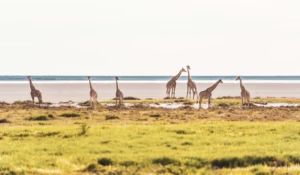
At a water hole near the Von Lindequist Gate, we saw something one is lucky to see once in a lifetime. As many as thirteen giraffes together, their slender long necks criss-crossing, as they stretched down awkwardly to drink, oblivious of a pride of black-stripped hyenas nearby! For some five minutes they ‘posed ’for us, then suddenly backed off from the water and loped away, stirring whirls of dust. “Probably a lion upwind,” our guide said matter-of-factly.
Etosha is all about vivid images. The one that sticks to mind is of a solitary elephant by the pool, his image reflected in the water. Soon, others would join him, and the intricate life cycle of the jungle would be acted and reenacted the way it has been for millions of years. We had rare animal sightings. And swirled dust in true desert fashion as we drove through one of the last frontiers of wildlife.
• Etosha is a few hours drive from Winhoek, Namibia’s capital and main gateway, served by international flights.
• The park is open to visitors throughout the year. Accommodation is available at the park’s three rest camps, Namutoni, Halali, and Okaukuejo, and in private lodges outside the park. The rest camps have private landing strips, restaurants, bars, shops, and fuel stations, and also provide literature and road maps.
• Visitors may not get out of their vehicles in the park area, and open vehicles, motorcycles, catapults, air-guns, and firearms are forbidden.
• Recommended are carrying along road maps of the park, binoculars, light-coloured clothing, sun-hats, and drinking water.