

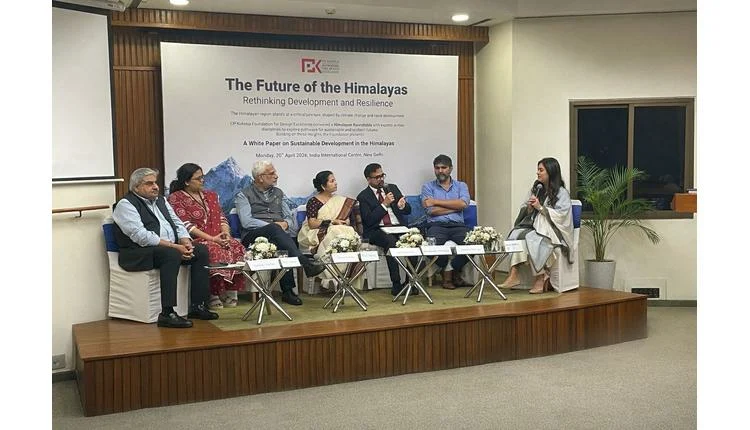
The CP Kukreja Foundation for Design Excellence (CPKF) unveiles its landmark White Paper titled “The Future of the Himalayas: Rethinking Development and Resilience” at the India International Centre, New Delhi. The launch was graced by Chief Guest Shri Pema Khandu, Hon’ble Chief Minister of Arunachal Pradesh.
The White Paper is the outcome of a multidisciplinary Himalayan Roundtable convened by the Foundation, bringing together experts across governance, infrastructure, ecology, governance, engineering, and social science to address the increasing complexity of development challenges in the region.
At a time when climate volatility, rapid infrastructure expansion, and ecological fragility are converging, the publication underscores the urgent need to rethink prevailing development paradigms in the Himalayas. It highlights that the Indian Himalayan Region has witnessed a 15–20% rise in extreme rainfall events since the 1950s, accompanied by growing landslide risks and mounting stress on infrastructure systems. The report positions these, not as isolated occurrences, but as interconnected consequences of a deeper structural misalignment between development approaches and the realities of fragile mountain ecosystems.
The White Paper calls for a fundamental shift in how development in the Himalayas is conceptualised and executed. Key recommendations include transitioning from project-led interventions to system-level planning, aligning development strategies with watershed and basin-scale ecological processes, integrating scientific data into governance frameworks, and adopting terrain-responsive, context-specific infrastructure design. It also underscores the importance of recognising ecological carrying capacity as a critical, non-negotiable parameter.
Importantly, the report reframes the Himalayas not as isolated geographies but as interconnected systems that directly impact nearly 1.3 to 1.5 billion people downstream across South Asia.
Introducing the White Paper, Dikshu C. Kukreja, Director, CP Kukreja Foundation for Design Excellence, said, “Development in the Himalayas must move beyond fragmented, project-led approaches to a more systemic and context-sensitive framework. Aligning infrastructure with terrain, data, and long-term resilience is no longer optional—it is essential. Through this White Paper, we aim to bridge the gap between research and real-world implementation, and to catalyse a more resilient, context-sensitive and future-ready approach to Himalayan development.”
Speaking at the launch, Shri Pema Khandu, Hon’ble Chief Minister of Arunachal Pradesh emphasised the need for a balanced approach to development in mountain states, highlighting that ecological preservation and economic progress must go hand in hand to ensure long-term sustainability. He expressed, “The Himalayas are at a critical juncture today, where the need for development must be carefully balanced with ecological sensitivity. While local communities seek growth and opportunity, it is essential that we adopt a calibrated, middle-path approach that safeguards this fragile ecosystem. The White Paper, ‘The Future of the Himalayas: Rethinking Development and Resilience,’ launched by the CP Kukreja Foundation for Design Excellence, is a timely step in this direction. Much like complex challenges require a coordinated, multi-pronged strategy, development in the Himalayan region must be approached through an integrated framework—combining scientific assessment, responsible planning, sustainable infrastructure, community participation, and strong policy alignment. It is important that institutions like NITI Aayog, along with policymakers, developers, and global stakeholders, work together in a mission-mode approach to embed long-term resilience and contextual understanding into every development decision.”
Positioned as a strategic framework rather than a prescriptive document, the White Paper identifies key structural gaps that continue to challenge Himalayan development. These include fragmented governance systems, underutilisation of scientific data, misalignment between engineering practices and terrain realities, and increasing pressures from tourism and rapid urbanisation.
A panel discussion on the sidelines of white paper release “Resilient and Sustainable Futures for the Himalayan Region”, featured an eminent line-up of experts, including:
- Anil Wadhwa, who has served as India’s Ambassador to Italy, Poland, Oman, and Thailand, bringing deep diplomatic and geopolitical insights into regional development
- Pradeep Sangwan, Environmentalist and Mountaineer, Founder of Healing Himalayas Foundation, known for his grassroots work in ecological restoration and waste management in the Himalayas
- Nar Bahadur Khatiwora, Regional Programme Head (Asia), International Solar Alliance, Renewable Energy Specialist and Programme Leader, with extensive experience in sustainable energy transitions across developing regions
- Virendra Kumar Paul, Director, School of Planning and Architecture, New Delhi, a leading voice in urban planning, policy, and sustainable built environments
- Siksha Swaroopa Kar, Senior Principal Scientist at CSIR–Central Road Research Institute and Associate Professor at the Academy of Scientific and Innovative Research, specialising in infrastructure resilience and transportation systems
- Mili Majumdar, Senior Vice President, Innovation and Research, U.S. Green Building Council, and Managing Director, Green Business Certification Institute, a key advocate for sustainable building practices and green certifications in India
CP Kukreja Foundation emphasised that addressing these challenges will require coordinated, cross-sectoral efforts anchored in data-driven governance, community-informed planning, and a long-term resilience lens rather than short-term gains.
The document concludes with a call for a new Himalayan development framework—one that is grounded in ecological limits, responsive to cultural contexts, and supported by institutional coherence.